Monday, January 31, 2022

BEN

Dear Harry,

This morning, aside from the usual online exchanges, I sent out an email to my old friend Ben. Do you remember him? It has been nearly two years since I last heard from him. He still lives in the north of England where he has spent most of his life. We were school chums at the age of seven or eight. He was the one friend I could always rely on, steady, unfazed by the cruelty or hostility of other boys. I no longer recall how it was that we reconnected just a few years back when we were both already grandfathers, but we met up at a pub somewhere in Hertfordshire, near where my son Matthew lives with his family and took a stroll together down a country lane, re-establishing our long, deep connection while the others in our party were starting on their before-dinner drinks in the lounge. 

Ben’s family lived in a large stone house perched on a hillside at the edge of Lake Windermere, and I stayed there with them once for a few days when I was about ten years old. I remember a dreadful and for me unusually acute attack of homesickness as I stood by the window of my cold little attic room, looking out over the gray lake, at dusk perhaps, and feeling, despite my welcome, terribly alone.

The next day I went with Ben down to the boathouse where they kept a small sailing dinghy and headed out onto the lake. Ben knew how to sail. What he did not know, could not have known because these strange weather conditions happen without warning, was that a squall was approaching us rapidly from the head of the lake. Before we knew it, the fierce gale attacked us with incredible force and bitter, driving rain. Never having experienced such a thing in my life before, I was terrified. Ben struggled to unfurl the sail while the little boat bucked and reared and twisted underneath us, threatening to sink below the sudden, angry waves. Stalwart as ever, he saw to it that we weathered out the storm and, after it had passed, rowed the dinghy back to the safety of the boat house.

This was the first time I had been in mortal anger. I was afraid, but not of death I think. Does any child so young have any real concept of death? Unless, I suppose, they have seen death take someone close to them.

Ben and I had lost touch already by the age of twelve, when we each went off to different boarding schools for the remainder of our school days. I learned that he had joined the ministry and had devoted his life, as you had done, to a parish priesthood. I’m sure he was the ultimate “good shepherd.” Long retired by the time we met again as old men, he had found a retirement passion as a beekeeper, tending to his bees with the same meticulous care, I’m sure, as he had tended to his flocks.

I wonder about bees. I wonder about their instinctive connectedness, as busy tribes zooming in and out of their hive, flying out in all directions—according, perhaps, to some unknowable plan—in search of nectar and returning to the hive to make their tiny, necessary contribution to the common weal.

And the queen, I wonder? Is she a benevolent but demanding monarch, a ruler of all those who occupy her domain? Or is she their servant, subject to the common will

I must ask Ben about this if I get the chance. I also want to talk to him about God. I want to ask him if he still believes, if belief is difficult for him. I want to share with him my disbelief, and yet an ancient, deep-felt longing for something to believe in.

Your son, Peter


Thursday, January 27, 2022

BLETCHLEY, REVISITED

Dear Harry,

My apologies for the long silence. Shortly after I last wrote I developed a truly horrible cold and have been laid up for several days. Fearing that I might have somehow contracted the latest variant of the current coronavirus epidemic, I even went to the hospital for a test, but happily that turned out negative. So what I've been suffering from is "just a cold."

But I have not been totally incapacitated. I have been able to write--and have been in touch with my Facebook "friends" (all three thousand of them; again, don't ask, it would take far too long to explain to a mind attuned to 20th century technology--BBC radio and the early days of television!) to keep them abreast of things. It is gratifying to know that I have such a great resource of people who care to read what I write, and sometimes even respond with their own thoughts and comments.

Otherwise, I have been reading--principally a long novel called "The Rose Code" by Kate Quinn, a book that I think you would have enormously enjoyed. As I have perhaps too frequently reminded you, you were always a great fan of tales of mystery and suspense, and this one would have especially intrigued you because its milieu is the place I wrote about in my letter last week: Bletchley Park. I reminded you of our personal connection with this incredibly hush-hush, historic center of World War II intelligence activity because we had three of those super-smart "Bletchley girls" living with in the Rectory at Aspley Guise. Believe it or not, three of those girls in Kate Quinn's book are billeted in a three-story redbrick Queen Anne house... in Aspley Guise! Sound familiar?

One of the three main characters in Quinn's book, all Bletchley girls, shares a lot of personal history with Sarah Baring, whose book we talked about together just last week--which irritated me a bit at the start, I have to say, until I discovered in an afterword that the borrowings were fully and forthrightly attributed. With the other two, all from quite different social backgrounds and of starkly different character, she leads us through the intense, at times harrowing experience of the work of those codebreakers on which the lives of so many service-men and -women came to depend. It's a compelling story of incredibly hard work, incredibly long hours, and above all the personal cost of the absolute imperative to maintain strict secrecy in such a hothouse environment. 

Quinn's skill is to wind the clock back as well as forward for her three young women, following their fortunes and misfortunes, their love affairs and poignant animosities, their loyalties and betrayals through the war years. What was an engaging read for the first half of the book becomes, in the second half, a real page-turner, galloping toward a climax in which the three friends rediscover their deep attachment even as they uncover a dreadful truth about the events at Bletchley Park. 

I was hooked. Okay, I'll confess that some remaining cynical part in my pragmatic, determinedly unsentimental male persona was irked by what seemed to me a few excessive moments of romance. But I was taken by the main characters--a "debutante" whose mother has a permanent suite at Claridges and is, before the war, presented to the King at court; a bright, keen, somewhat cynical social climber from the working-class East End of London; and a shy, seemingly slow-witted country girl, bullied horribly by her mother, who hides an Asperger's genius mind within. I was taken, too, as much by the gripping images of London in the Blitz as by the tense, harried scenes in the "huts" of Bletchley Park.

All in all, an excellent read, Harry, and one you would have loved--as you loved those Bletchley girls!

Gratefully---this time for the love of books like this!--your son, Peter

Wednesday, January 19, 2022

BLETCHLEY

 Dear Harry, 

I have been reading more about Bletchley Park, this time in a book called "The Secrets of Station X: How Bletchley Park Helped Win the War" by Michael Smith. As I read, I come across names thaqt sound familiar, names of people who were your friends during the war years and after. I'm sure you remember Hugh Trevor-Roper, for example, and Peter Calvocoressi who lived just a few yards down the road from us in Aspley House--a mansion that was reputed to be haunted by one of those "gray ladies" familiar to anyone who knows about ghosts in English country houses. This one was supposed to be seen walking occasionally down the wide main staircase that led to the front hall. It was Peter Calvocoressi, by the way, who was an editor at Chatto & Windus in the late 1950s when I was getting started as a writer. He was kind enough to read the manuscript of a very derivative first novel I had written and was arrogant enough to think deserved publication! He turned it down, of course, but was decent enough to write me a letter with some encouraging words--thanks, I'm sure, to his friendship with you and Peggy. There was also mention of another analyst named Hugh Foss who had a cottage in Aspley Guise--the book describes it as a horrible mess, with dishes stacked on the floor. I don't recall the name myself, but I wonder if you remember him?

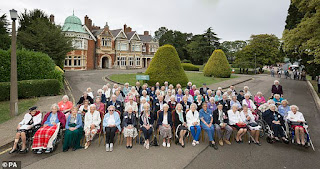
No mention, yet, of any of the girls who lived with us at the Rectory. Would you recognize and of them from this contemporaneous image...


... or as they are today!


But it's fascinating to read about what was going on under our noses during those war years. You would love to have known about it all--and indeed tried quite improperly to pump our guests for information, as I've read. I'm trying to work out if you were still alive when the history of Bletchley started to be released, some fifty years after the war ended. Until then it was all a closely guarded secret. Since then, of course, there have been countless books, television programs, movies--the best know of the latter being "The Imitation Game" with Benedict Cumberbatch in the role of the ill-fated Alan Turing. 

I don't know, really, what got me started on this kick. Perhaps my curiosity was nudged by a couple of letters that are included in my "Dear Harry" book. It does feel like an important part of my childhood, as though I was at least close to some critical part of 20th century history. It's something I'd love to talk to you about, if you were still around...

Sent with love, as always, your son Peter

Monday, January 17, 2022

MLK

It's MLK Day here in the US--the day on which we celebrate the life and work of Dr. Martin Luther King. Thanks to his leadership--and the work and leadership of countless others in the 1960s--the Voting Rights Act was signed by President Lyndon Johnson in 1965. It was a moment of great joy, seeming to finally put paid to the Jim Crow laws that had hobbled the rights of African Americans for decades. 

With increased access to the polls, the prospect for a better, more just, more equitable future seemed momentarily bright. Now look where we are. Led on by the delusional fury of the man rejected from the presidency in the 2020 election, representatives of one political party are working assiduously throughout the country to reverse the progress made by Dr. King and those who worked with him. Motivated by the clear understanding that their prospects in a fair and cleanly run election are dim, they are resorting to every conceivable way to win by voter repression, district gerrymandering, control of the election bureaucracy and other forms of outright cheating.

There seems to be no way to stop these people. They have been working cannily for decades to assume control of the political process, from school boards to city and state governments. Democrats, for their part, have believed--naively, it now seems--in small "d" democratic fair play. Now threatened with the disastrous prospect of a Republican takeover of the House and Senate in 2022 and a further consolidation of their increasingly autocratic right-wing control--they are already threatening to take partisan revenge on Democratic opponents, and even impeach President Biden for unspecified crimes--the only way to stop this long downhill slide from MLK's 1960s is to activate unimaginable numbers of oppressed and reasonable Americans and persuade them to defeat every obstacle designed to keep them from the polls. It will be a Herculean task.

Dr. King asserted that the "arc of the moral universe" may be long, but that it "bends towards justice." Unhappily it has been seized in recent years by those who have nothing but contempt for social justice and seek to distort it to their own nefarious ends. May Dr. King prove right in his guarded optimism, and may this country finally reset its course toward the aspirations of its founders. Flawed as we now know them to be, they had a vision that transcended the limits of their personal lives and projected a possibility for humanity that continues to elude us. 

Sunday, January 16, 2022

EMAIL

 Dear Harry,

I was just thinking as I was going through the tedious daily ritual of deleting unsolicited email after unsolicited email--dozens of them, in fact--that you never, ever received one of these during your entire life. You never opened a computer, never racked your brains to remember a bloody "password", never Googled anything... You never had a telephone where you could check the weather anywhere in the world, visit the stock market, find the solution to the daily crossword puzzle. make a "FacetTime" video call to someone in Australia--for "free"!--never hit the "send" button by mistake, before you'd finished your text, never made a "butt call" and would not have the first idea what that might mean. 

Whatever did you do without it?

In the days when telephones were telephones, attached to the wall with a cable that only reached so far, you had to "dial" the number you wished to reach on the rotary dial. Calling required some physical action beyond one finger (thumbs, it seems, for the young and those more expert than myself) hovering over the keypad. There was a sense of "connection" through the wires. For most of your life, if there was no one at the other end of the line to receive your call, you could not "leave a message". You'd have to try again another time. As for international or transatlantic calls, particularly at Christmas, don't even ask...

Well, Harry, times have changed. I now carry my phone in my pocket everywhere I go. It takes photographs! Or movies! And transfers them instantaneously to anyone I want to send them to! No more loading film into the camera and taking it to be "developed"! Oh, it's all so convenient, so easy, Harry. You can manage your entire life on this little thing, smaller even than a pack of twenty cigarettes. Imagine. 

And oh, by the way, I'm "posting" this on my "blog." Again, don't ask.

With love, Peter

Wednesday, January 12, 2022

MARMALADE (Part 2)

 So the Meyer lemon marmalade is done. Looks good. Tastes pretty darn good, too!


I'm pretty chuffed with myself!


Tuesday, January 11, 2022

MARMALADE

Today is another marmalade day. Another, because I made some kumquat marmalade a couple of weeks ago (did I mention this before?) Today it's Meyer lemon marmalade. We have both these fruit trees out on the top deck of home in Los Angeles, and this year has been a good one for both. It's hard to know what to do with so many Meyer lemons (we also have a heavily-laden tree with regular lemons) and so many kumquats except to make marmalade, and even then my marmalade-making ambitions make only a modest dent in our supply of citrus fruit. It's a shame that they all seem to ripen at the same time...


Still, it's an interesting and enjoyable occupation. It reminds me of the time when my mother, Peggy, would make big vats of Seville orange marmalade and various kinds of jams, depending on what fruit happened to be ripening in our garden. I remember the wonderful aromas that wafted through the house as she stirred those big pots with wooden spoons on the coke-burning stove, calling my sister Flora and myself to the kitchen for a spoonful of the tasty "scum" our mother scooped from the surface as the mixture simmered. That was a special treat.

There are only two habits that I brought over with me from England when I left my native country more than sixty years ago. One of them is my indispensable morning cup of tea, and the other is marmalade. I was dismayed, when I first came to America, to be served orange jam in the guise of marmalade when I went out for breakfast. Jam is jam. Marmalade is marmalade. Because "proper marmalade" is made with tart Seville oranges, it has a tang to it. Jam is sweet. Big difference. For breakfast, I need marmalade. Not jam. Not honey. Marmalade. I'm a bit of a snob that way.

I'm posting today about "Bipolar Bear," a memoir by my friend Carl Davis--a man whom many of you know from his presence as an ...